Recently, Professor Linghai Xie from Academician Wei Huang? s team at the State Key Laboratory of Organic Electronics and Information Displays at Nanjing University of Telecommunications (NJUPT), has made ignificant progress in the design and gridization synthesis of macrocyclic organic nanohydrocarbons (ONHCs) with wide-bandgap ultraviolet luminescence.The results were published in Nature Communications under the title C-H-activated Csp2-Csp3 diastereoselective gridization enables ultraviolet-emitting stereo-molecular nanohydrocarbons with mulitple H···H interactions. Associate professor Ying Wei and Dr. Chunxiao Zhong are co-first authors of the paper, and Prof. Jinyi Lin, Prof. Linghai Xie and Academician Wei Huang are the co-corresponding authors.

Flexible ultraviolet (UV) light-emitting devices have important applications in wearable lighting, sensing, light sources, communication, and medical fields. However, currently, the efficient and stable UV light-emitting wide-bandgap semiconductors are mostly inorganic semiconductors, which are difficult to meet the needs of future consumer electronics and related fields. Therefore, innovative molecular design platforms and molecular creation of organic ultra-wide bandgap (Eg>3.6 eV) ultraviolet luminescent materials are of great significance for the development of flexible wideband gap ultraviolet luminescent materials and devices.
The difficulty in developing and constructing UV luminescent molecular platforms lies in the fact that the linking process of luminescent groups can lead to spectral redshift, especially for π-conjugated groups. For example, the well-known basic methods for regulating electronic structure, such as the donor-acceptor (D-A/p-n) strategy, the polycyclic strategy, the polymerization strategy, and the macrocyclization strategy are prone to severe redshift in fluorescence spectra, which in turn causes the originally UV-emitting construction units to enter the visible light emission region (> 400 nm) after forming a hierarchical structure. Additionally, these problems such as defect-induced low-energy long-wave luminescence caused by stable polycyclic aromatic ring structures, aggregation-induced luminescence quenching and redshift behavior, and luminescence spectral redshift caused by ring strain tension make the development of flexible ultra-wide bandgap blue and UV light materials face unprecedented challenges.
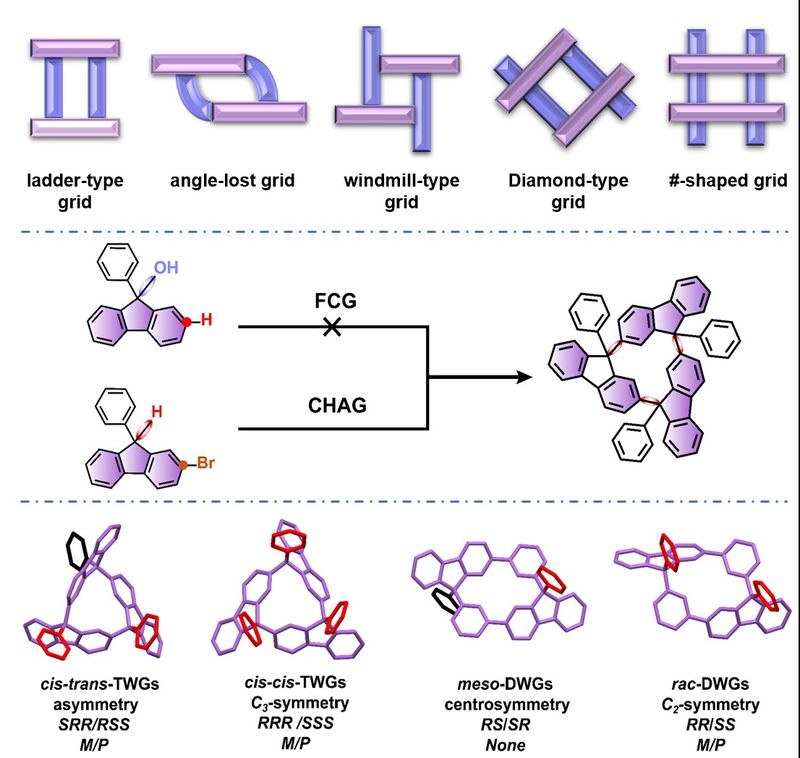
Figure 1. Five types of nanogrids, triangular windmill grid and its specific molecular structure of organic nanogridarenes
In the above context, Professor Linghai Xie and Academician Wei Huang's team proposed the gridization strategy and established the fluorene-based gridization chemistry and its molecular platform based on the macrocyclic strategy. In this work, they broke through the Friedel-Crafts gridization method and proposed a non-conjugated supersteric hindrance molecular design strategy as well as a diastereoselective gridization method based on C-H activation to obtain ultraviolet-emitting carbon-hydrogen nanogrid materials with excellent diastereoselectivity and high luminescence dissymmetry factor. On one hand, the transition state in the C-H activation reaction can be utilized to release the ring tension and regulate its stereo configuration, in order to overcome the problem of achieving the 2,9-position connection of fluorene molecules in Friedel-Crafts gridization and achieving the high diastereoselective synthesis of carbon-hydrogen strained nanogrids. On the other hand, by introducing Csp3 into the molecular framework, its non-conjugation and non-planarity can be utilized to overcome the problems of spectral redshift and poor film-forming properties, thus achieving ultraviolet emission based on strained nanohydrocarbons.
The C-H activated gridization method developed based on the above ideas has successfully synthesized a special class of macrocycles, namely molecular nanohydrocarbons (MNHCs, Figure 1) composed of pure carbon and hydrogen elements. The use of conjugation blockade suppresses the redshift of the emission spectrum, and the non-planar three-dimensional configuration effectively suppresses the aggregation of intermolecular chromophores. As a result, not only ultraviolet emission was achieved (with an emission peak at 356-393 nm), but also high luminescence dissymmetry factor (|glum|=0.012). Importantly, non-doped organic light-emitting diode devices (OLEDs) based on this carbon-hydrogen nanogrid achieved an external quantum efficiency of up to 4.17% (λEL=386 nm, CIE: 0.17, 0.04) (Figure 2). This represents the highest efficiency of UV OLEDs based on pure hydrocarbons, and is also the first application of macrocyclic compounds in ultraviolet OLEDs. This result not only provides a feasible approach for the development of carbon hydrogen tension macrocycle materials with ultraviolet and circularly polarized luminescence, but also verifies the feasibility of using non-conjugated steric hindrance molecular design strategies for efficient UV OLED emitting layer material design.
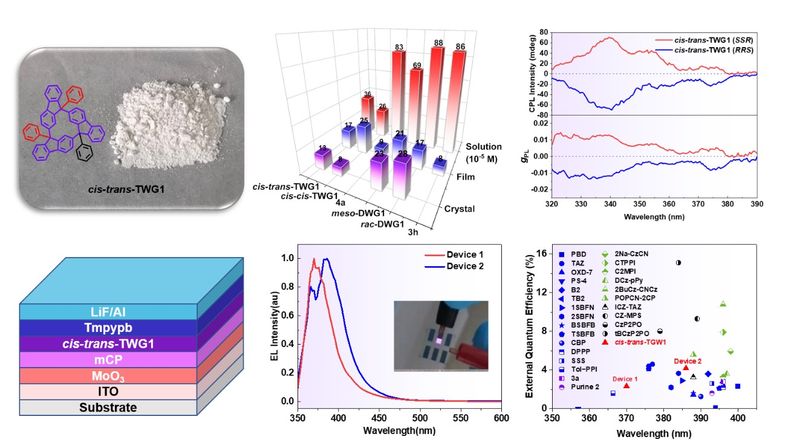
Figure 2. Material morphology, circularly polarized luminescence behavior, and UV OLED of triangular windmill grid-like organic nanohydrocarbon
This research achievement was guided by Associate Professor Juan Song from the School of Materials Science and Engineering at Nanjing University of Posts and Telecommunications, with the assistance and support of Professor Zhiming Wang and Dr. Jingli Lou from South China University of Technology, and Professor Youxuan Zheng from Nanjing University. It was a collaborative effort with Senior Researcher Ilya A. Khodov from the Krestov Institute of Solution Chemistry, Russian Academy of Sciences, the Frontiers Science Center for Flexible Electronics at Northwestern Polytechnical University, and Henan Provincial Flexible Electronics Industry Technology Research Institute. This research project was supported by the National Basic Science Center for Flexible Electronics, the Natural Science Foundation of China, and an open project of the State Key Laboratory of Luminescent Materials and Devices at South China University of Technology.
(Written by Linghai Xie, Initially Reviewed by WenYong Lai, Edited by Cunhong Wang, Reviewed by Feng Zhang)