The research team led by Professor Lai Wenyong from the National Key Laboratory of Flexible Electronics and the School of Chemistry and Life Sciences at Nanjing University of Posts and Telecommunications (NJUPT) has made significant progress in the design, preparation, and functional regulation of flexible crystalline photoelectric thin films. Their proposed Interface Preassembly Oriented Growth (IPOG) strategy offers a novel solution to the long-standing scientific challenge of balancing material crystallinity and flexibility.
Focusing on the structure-property relationship of conjugated organic framework (COF) materials, the team achieved synergistic control of optoelectronic properties and mechanical performance through molecular design. The related findings, titled Interface Preassembly Oriented Growth Strategy Towards Flexible Crystalline Covalent Organic Framework Films for OLEDs, were published in Nature Communications (2025, 16, 3321).
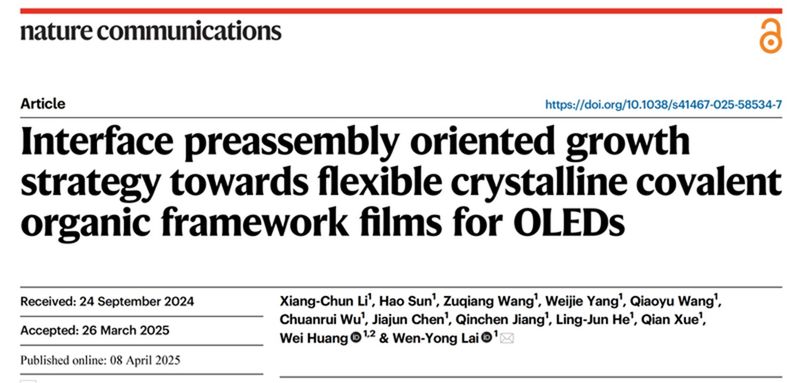
Research Breakthrough on Flexible Crystalline Photoelectric Films by Prof. Lai Wenyong’s Team Published in Nature Communications
Flexible electronics, as a key enabling technology for next-generation information systems, show tremendous potential in artificial intelligence, human-machine interaction, wearable devices, and smart diagnostics. However, their core materials have long faced a dilemma: highly crystalline materials exhibit superior optoelectronic performance but are brittle and prone to fracture, while flexible polymers can bend freely but suffer from disordered structures that limit their optoelectronic properties. For instance, traditional COF materials are restricted in flexible electronics applications due to their inherent brittleness and low flexibility caused by high crystallinity.
Inspired by the precise regulation mechanism of hydrophilic/hydrophobic interactions in biological systems, the research team innovatively proposed the IPOG strategy. By introducing functional groups (hydrophilic/hydrophobic chains) to control molecular interface preassembly behavior, the team achieved directional monomer alignment at the oil-water interface through synergistic interactions of these groups. Subsequent acetic acid-catalyzed liquid-liquid interfacial polymerization produced flexible crystalline photoelectric films with controllable thickness (100-300 nm) and large area (up to 20 cm2).
X-ray diffraction (XRD) analysis confirmed the high crystallinity of the resulting amphiphilic flexible crystalline films. Precise thickness control from nanometer to micrometer scales was achieved by adjusting monomer concentration and reaction time. The study demonstrated that introducing flexible side chains expanded the interlayer spacing from 3.52 ? to 4.01 ?—analogous to “pulling open a drawer” at the molecular level—effectively suppressing luminescence quenching caused by π-π stacking in rigid crystalline materials. This increased the solid-state film's photoluminescence quantum yield by 60-fold. The films could withstand repeated bending and even stretching without breaking, surpassing the mechanical limits of traditional crystalline materials.

Interface preassembly oriented growth and COF structure diagram
Based on this breakthrough, the team constructed the first COF-based flexible organic light-emitting diode (OLED) prototype. The device achieved record-high photoelectric conversion efficiency for its class, with emission color tunable from deep blue to white through voltage modulation—offering a new approach for smart dynamic displays. The study also tracked the COF film's interface preassembly, directional growth, and crystallization processes using time-resolved SEM, XRD, and FTIR, providing experimental evidence for understanding material growth dynamics.
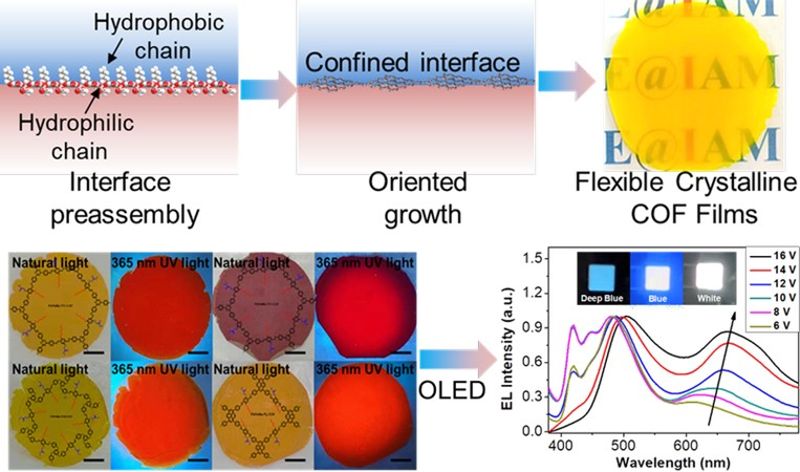
Crystallization growth mechanism and OLED application
This work reveals the mechanism of hydrophilic/hydrophobic interactions in regulating material micro/nanostructures from a molecular engineering perspective, establishing a theoretical foundation for designing photoelectric functional films that combine high crystallinity and flexibility. The IPOG strategy’s precise “structure-property” control capability opens new avenues for developing electronic materials with both skin-like flexibility and semiconductor performance.
The team is now further exploring COF materials’ charge transport mechanisms and device interface optimization to advance their applications in flexible displays, flexible sensors, and bio-inspired electronics.
The paper’s first author is Associate Professor Li Xiangchun from the National Key Laboratory of Flexible Electronics and the School of Chemistry and School of Chemistry and Life Sciences of NJUPT, with corresponding author Professor Lai Wenyong from the same institutions. This research was supported by the National Key R&D Program of China, NSFC Key Projects, and Jiangsu Provincial Key R&D Program.
(Author: Liu Lin; Initial Review: Qiao Zuqin, Luo Zhimin, Dai Xiubin; Editor: Wang Cunhong; Approved by: Zhang Feng)